
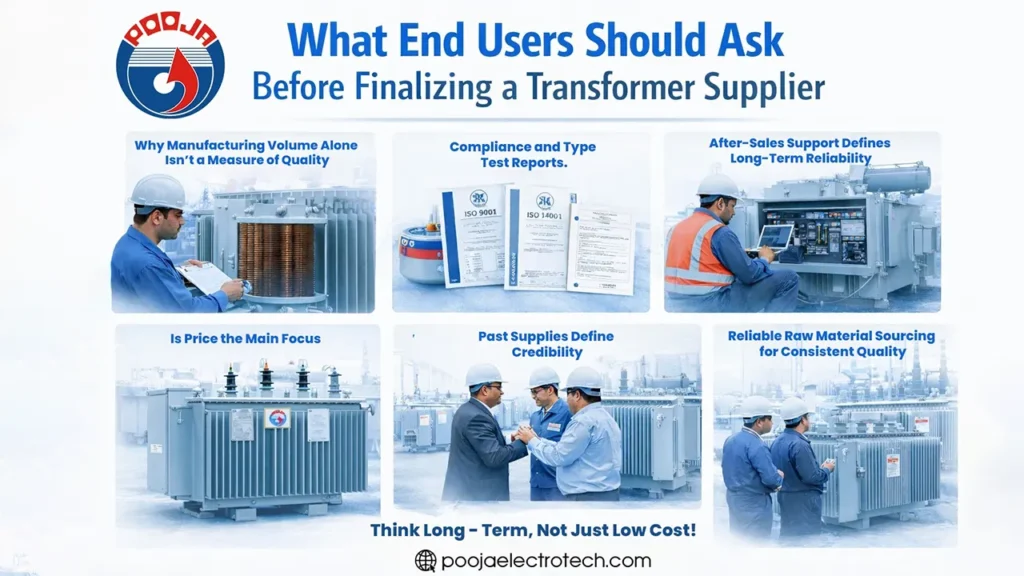
Choosing a transformer supplier is not just a procurement decision—it’s a long-term operational commitment. While ratings and delivery timelines matter, the real differentiators lie deeper. Before finalizing a supplier, end users should ask the right questions that go beyond brochures and quotations.
1. More Than Manufacturing Capacity — Does Quality Truly Matter?
High production numbers may look impressive, but capacity alone does not guarantee consistency. Ask about design philosophy, loss optimization, insulation systems, and quality checkpoints across manufacturing stages. A reliable supplier prioritizes performance and longevity over sheer volume.
2. Are Certifications and Type Test Reports Transparent and Verifiable?
Always verify valid type test reports, routine test protocols, and ISO certifications. These are not formalities—they are evidence of compliance, discipline, and repeatability in manufacturing. Authentic documentation reflects a serious approach to quality.
3. What Does After-Sales Service Really Look Like?
Transformers are expected to operate reliably for decades. Ask about commissioning support, response time for site issues, spare availability, and technical troubleshooting. Strong after-sales service often separates dependable partners from short-term vendors.
4. Have You Spoken to Their Existing Customers?
First-hand feedback is invaluable. Speak to other end users who are operating similar transformers from the same supplier. Their experience with performance, breakdowns (if any), and service response will give you insights no datasheet can.
5. Do They Control and Verify Their Raw Material Sources?
Core steel, copper, insulation, oil—raw materials define transformer performance. Ask for the approved vendor list and, if possible, verify it physically. A manufacturer confident in their supply chain has nothing to hide.
6. Is Price Given Too Much Importance?
Ironically, price should carry the least weight in the decision. A lower upfront cost often leads to higher losses, increased downtime, and premature failures. Total Cost of Ownership (TCO)—including losses, maintenance, and lifespan—matters far more than the initial invoice value.
7. Can You Audit and Opt for Third-Party Testing?
Whenever feasible, conduct a manufacturing audit and insist on third-party testing before final inspection. Independent validation adds an extra layer of assurance and significantly reduces long-term risk.
8. Do Their Testing Standards and Equipment Truly Reflect Reliability?
This is where a transformer’s true quality is proven. It’s not just about which tests are listed on paper, but how those tests are performed and the quality of equipment used to perform them. Well-maintained, accurately calibrated testing systems play a crucial role in validating real-world performance.
Efficient and advanced testing equipment helps detect hidden weaknesses early, ensures consistent results, and reduces the risk of failures during operation. A manufacturer that invests in strong testing infrastructure shows a clear commitment to safety, compliance, and long-term reliability—going beyond minimum requirements to deliver confidence that lasts for decades.
Conclusion
At Pooja Electrotech Private Limited, we believe a transformer should be evaluated as a long-term asset, not a short-term purchase. Transparent processes, quality-focused manufacturing, verified materials, and dependable after-sales support are principles we work by every day.
As end users, asking the right questions upfront leads to safer operations, better efficiency, and fewer surprises over the transformer’s lifetime.
Because in critical infrastructure, informed choices always pay back.


