
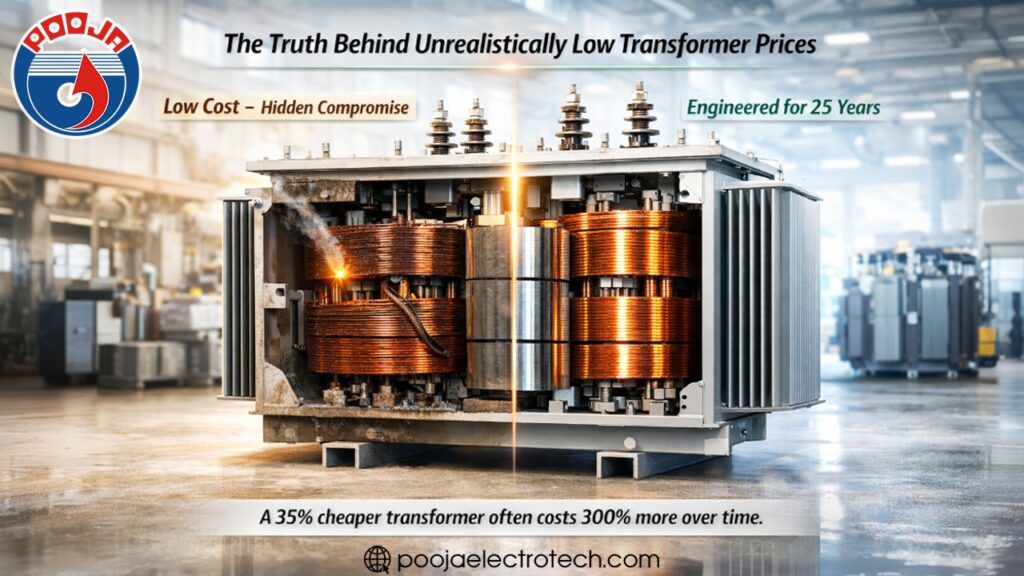
Every procurement cycle, it happens. A quotation arrives with the same specifications on paper — same kVA, same voltage rating — but the price is 35% lower than every other bid on the table. That number is magnetic. It often feels like a smart saving. But in many cases, it’s actually a warning signal disguised as an opportunity.
A transformer cannot be made infinitely cheap. When a unit is priced significantly below market benchmarks, the math usually points to the same place: material substitution and engineering compromise.
Here’s what typically gets cut — and what it ends up costing you in the field.
Copper — The Most Tempting Place to Cheat
Copper is the single largest cost driver in a transformer’s bill of materials, which makes it the first target for budget manufacturers. The practice is known in the industry as “copper shaving” reducing winding conductor cross-sections below design-optimal levels. On a nameplate, the transformer looks identical. Inside, the physics change entirely.
Undersized windings mean higher resistance, greater heat generation under load, and accelerated insulation breakdown. A transformer engineered for 25 years of service life, built with shaved windings, can reach functional failure within 5 to 7 years. The failure looks like bad luck. It was decided the day the winding was wound.
CRGO Core Steel — Where Efficiency Is Quietly Surrendered
Cold-Rolled Grain-Oriented silicon steel determines how efficiently a transformer handles magnetic flux. Budget manufacturers substitute non-certified or lower-grade steel that fails to meet M3, M4, or M5 specifications. The consequences are chronic and compounding, higher core losses, elevated no-load current, and thermal instability that progressively degrades surrounding insulation.
This cost never appears on the purchase order. It appears silently on every electricity bill and maintenance record for the next two decades.
Insulation Systems — The Component That Determines Survival
Insulation is what allows high voltage and high current to coexist safely within a transformer across thousands of operating hours. Budget manufacturers cut here in several ways — lower thermal class paper, uncertified or recycled transformer oil, inadequate drying and vacuum impregnation before tanking, and reduced creepage distances that strip away the safety margin against voltage surges on live networks.
Insulation failure is rarely gradual. It is typically sudden, catastrophic dielectric breakdown — with outcomes ranging from complete transformer destruction to fire.
Testing — The Final Line of Defence, Routinely Abandoned
Routine factory tests and third-party type tests exist for one reason: to prove that a transformer will perform to specification under real operating conditions. Budget manufacturers skip them or issue internally fabricated test certificates formatted to satisfy procurement reviewers who rarely have the bandwidth to verify them independently.
A transformer without genuine, accredited test documentation is not a tested transformer. It is an untested transformer with persuasive paperwork.
The Pooja Electrotech Commitment
At Pooja Electrotech Pvt. Ltd., every transformer leaves our facility built to IS 1180 and IEC 60076 standards — using verified-grade CRGO steel, electrolytic copper, and certified insulation systems, with complete routine testing on every unit. Our designs are backed by CPRI and third-party type test documentation, available to any buyer who asks.
We export to EPC contractors, and industrial clients across Africa, the Middle East, and Southeast Asia — buyers who chose us not because we were the lowest quotation, but because when they asked the hard questions, we had documented answers.
The right transformer operates for 25 years and is forgotten. The wrong one reminds you of itself at the worst possible times.


