
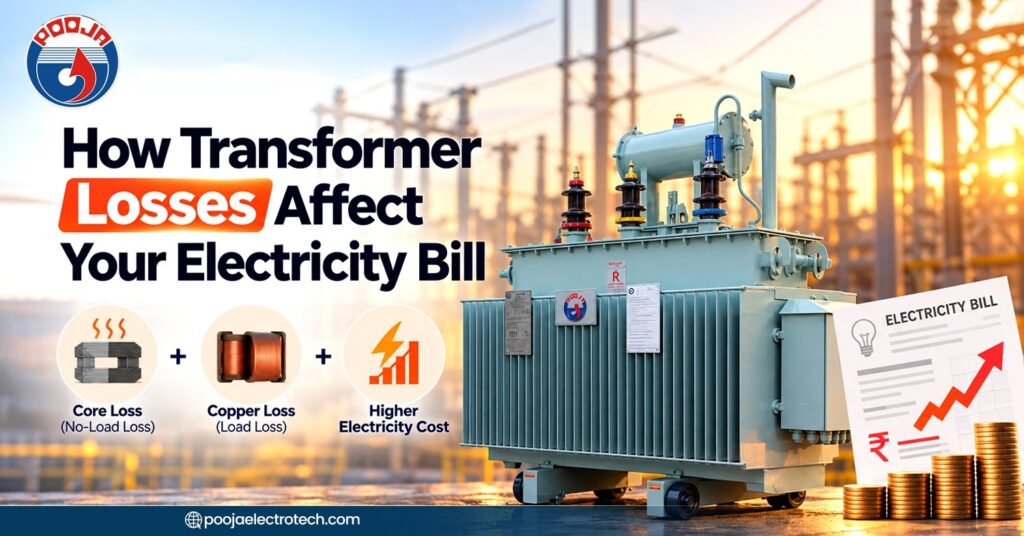
Your transformer may be sitting idle, but it is still costing you money.
A transformer can remain energized 24 hours a day, 365 days a year. Even when your plant is operating at low load—or temporarily shut down—the transformer continues to draw a certain amount of power from the supply.
That power is mainly associated with no-load losses, and over the lifetime of a transformer, these losses can add up to a significant amount of energy and cost.
What exactly are transformer losses?
A transformer cannot transfer 100% of the input power to the output.
The difference between the input and output power is primarily lost as heat, and these losses are generally divided into two main categories:
No-load losses, or core losses, and load losses, commonly referred to as copper losses.
1. No-Load or Core Losses
No-load losses occur whenever the transformer is energized, regardless of whether it is supplying significant load.
These losses are mainly associated with the magnetic core and include:
- Hysteresis losses
- Eddy current losses
Unlike load losses, core losses remain relatively constant with changes in load, as long as the applied voltage and frequency remain essentially constant.
So, if a transformer remains energized continuously, these losses continue 24/7—during production, shutdowns, weekends, and holidays.
2. Load or Copper Losses
The second major component is load loss.
When current flows through the transformer windings, resistance in the conductors produces heat. This is commonly expressed as:
Copper Loss ∝ I²R
This is important because the loss increases with the square of the current.
For example, if the load current doubles, the winding loss does not simply double—it can increase by approximately four times, assuming the winding resistance remains constant.
This is why operating a transformer continuously at high load can significantly increase energy losses and temperature rise.
So, what does this mean for your electricity bill?
Let’s take a simple example.
Suppose a plant has a 1000 kVA transformer, and one transformer has just 2 kW higher total losses than another comparable, more efficient design.
If the transformer remains energized for 8,760 hours a year:
2 kW × 8,760 hours = 17,520 kWh per year
At an illustrative electricity tariff of ₹8 per unit, that represents approximately:
₹1.4 lakh of additional energy cost every year.
And remember—this is only a 2 kW difference in losses.
Over a 25–30 year transformer life, the cumulative energy cost can become substantial.
And if a plant has multiple transformers, the impact multiplies.
But losses aren’t only about electricity cost.
Higher losses mean more heat is generated inside the transformer.
Higher temperature can accelerate insulation ageing and increase thermal stress on the transformer.
Over time, this can affect:
Efficiency → Temperature Rise → Insulation Life → Reliability
And an unplanned transformer shutdown can cost an industrial plant significantly more than the electricity lost through inefficiency.
So, should you simply buy the transformer with the lowest losses?
Not necessarily.
The objective is to select a transformer based on its total cost of ownership, rather than looking only at the initial purchase price.
A proper evaluation should consider:
- No-load losses
- Load losses
- Expected load profile
- Annual operating hours
- Electricity tariff
- Transformer loading
- Expected service life
- Loss capitalization, where applicable
This is particularly important when preparing technical specifications or comparing competing transformer offers.
Where does transformer efficiency come from?
Efficiency is not achieved by one component alone.
It is engineered through:
High-quality core material + optimized magnetic design + optimized winding design + suitable conductor selection + accurate manufacturing + proper assembly + rigorous testing.
And there is another important factor:
Correct transformer sizing.
An oversized transformer may operate at a very low load, while its no-load losses continue whenever it is energized.
An undersized transformer, on the other hand, may operate at high load for extended periods, increasing I²R losses and temperature rise.
The right transformer is therefore not simply the biggest or the cheapest one.
It is the transformer properly matched to the actual load profile and operating conditions.
Experience That Matters
At Pooja Electrotech, we bring over 35 years of experience in transformer manufacturing and field applications.
We manufacture and export Industrial Distribution Transformers, Power Transformers, Special Purpose Transformers, Inverter Duty Transformers, Compact Substations, Automatic Voltage Controllers, HT AVR systems and Silicon Power Rectifiers.
Our focus is on designing and manufacturing reliable transformer solutions with attention to losses, temperature rise, efficiency and long-term operating performance.
Final CTA
So, the next time you evaluate a transformer, don’t look only at the purchase price.
Look at what that transformer will cost you every hour, every day, and throughout its service life.
Because the cheapest transformer to buy is not always the most economical transformer to own.
Make transformer efficiency part of your energy strategy.
Pooja Electrotech — Engineering Reliable Power Solutions.


