
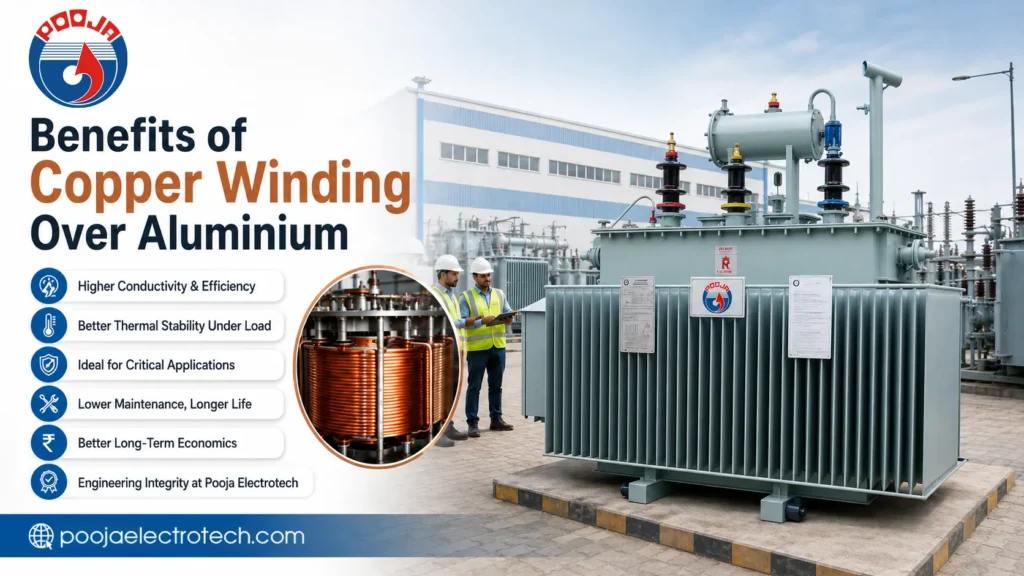
When specifying a transformer, one of the most important decisions is the choice of winding material. While aluminium windings are often considered due to their lower initial cost, copper remains the preferred choice for applications where efficiency, reliability, and long-term performance matter.
At first glance, the cost difference between copper and aluminium may seem significant. However, when evaluated over the entire life cycle of a transformer, copper offers several advantages that often outweigh the higher upfront investment.
1. Higher Electrical Conductivity
Copper has significantly higher electrical conductivity than aluminium. This allows a copper-wound transformer to carry the same current with lower resistance, resulting in reduced copper losses (I²R losses).
Lower losses mean:
- Improved energy efficiency
- Reduced operating costs
- Lower heat generation
- Better overall transformer performance
For transformers operating continuously, even small efficiency gains can translate into substantial savings over the equipment’s lifetime.
2. Better Thermal Performance
Copper handles thermal stresses more effectively than aluminium due to its superior conductivity and higher melting point. This results in:
- Improved heat dissipation
- Reduced risk of hot spots
- Better performance during overload and sudden load conditions
- Longer insulation life
3. Higher Mechanical Strength
Copper possesses greater mechanical strength than aluminium, making it more resistant to deformation caused by electrical and mechanical stresses. This provides:
- Improved winding stability
- Enhanced short-circuit withstand capability
- Better resistance to sudden jerk loads
- Greater reliability in demanding applications
4. Compact Design
Because copper carries more current for a given cross-sectional area, transformers can often be designed with more compact windings.
Benefits include:
- Reduced winding dimensions
- Better utilization of core space
- Improved cooling characteristics
- Higher power density
5. Lower Maintenance Requirements
Over time, aluminium conductors are more susceptible to loosening at joints and connections due to thermal expansion and contraction cycles.
Copper’s superior mechanical and thermal properties help maintain stable electrical connections, reducing the likelihood of maintenance issues and unexpected downtime.
6. Lower Total Cost of Ownership
Although copper-wound transformers typically have a higher purchase price, the long-term economics often favor copper.
The savings come from:
- Lower energy losses
- Reduced maintenance costs
- Improved reliability
- Longer service life
- Fewer operational interruptions
For industrial facilities operating around the clock, these benefits can far exceed the initial price difference.
Why It Matters
Consider a transformer supplying a critical manufacturing process. A transformer failure doesn’t just mean repair costs—it can lead to production losses, missed delivery schedules, and operational disruptions.
In such applications, reliability becomes far more valuable than the initial purchase price.
The Pooja Electrotech Approach
At Pooja Electrotech, we believe that a transformer should be evaluated not only by its purchase cost but by the value it delivers throughout its operating life.
For this reason, we continue to emphasize high-quality materials, optimized designs, and robust manufacturing practices that help our customers achieve lower losses, higher reliability, and longer service life.
Conclusion
Aluminium windings certainly have their place in specific applications where initial cost is the primary consideration. However, for users seeking maximum efficiency, durability, and long-term value, copper remains the benchmark.
When selecting a transformer, the right question is not simply, “What does it cost today?” but rather, “What will it cost over the next 20 years?”
In most cases, the answer points to copper.
Invest once. Save for decades.


