
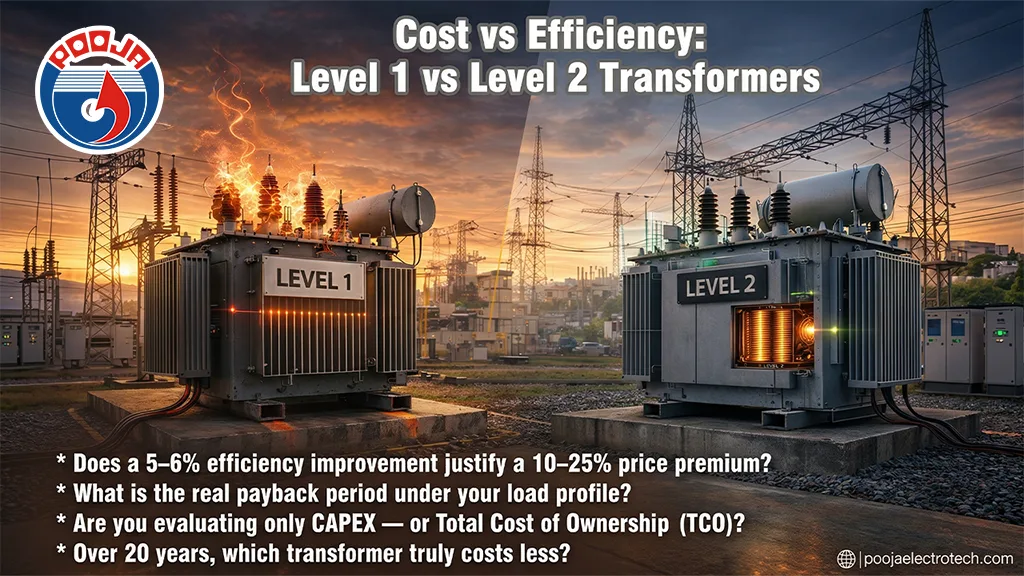
In the field of power distribution, transformer selection is rarely a one-size-fits-all decision. For industrial buyers, utilities, and procurement teams worldwide, the choice between Level 1 and Level 2 energy-efficient distribution transformers — as defined under IS 1180 (Part 1): 2014 and comparable international efficiency standards IEC 60076 — carries significant financial and operational implications over the transformer’s service life.
Understanding the Standards
IS 1180 (Part 1): 2014 classifies distribution transformers into efficiency levels based on the maximum permissible total losses at 50% load and at 100% load. Level 1 transformers meet the baseline efficiency requirements, while Level 2 transformers comply with more stringent loss limits—typically resulting in about 5–6% lower total losses compared with Level 1 units. Achieving these lower losses generally involves the use of higher-grade core materials, such as improved Cold Rolled Grain Oriented (CRGO) silicon steel or amorphous metal alloys, along with optimized winding design, which often includes a higher copper cross-section to reduce load losses.
A key point in IS 1180 is that it evaluates total losses at specified loading conditions (50% and 100%), rather than specifying individual limits separately for no-load and load losses.
In contrast, standards such as IEC 60076 and IS 2026 define transformer losses primarily as:
- No-load losses (core losses) — measured when the transformer is energized but not supplying load.
- Load losses (copper losses) — measured at rated current, typically at 100% load.
This distinction is important because no-load losses occur continuously whenever the transformer is energized, regardless of the load being served. Load (copper) losses, on the other hand, vary with the square of the load current. Together, these two components determine the transformer’s overall efficiency, operating cost, and lifecycle economics in real operating conditions.
The Cost Equation: Purchase Price vs. Lifecycle Reality
A Level 2 transformer typically commands a 10–25% premium over its Level 1 equivalent, depending on the rating and construction. For budget-sensitive projects or procurement teams evaluated on capital expenditure alone, this gap can appear prohibitive. However, the calculation changes substantially when evaluated over a 20–25 year operational life.
Consider a 2500 kVA transformer operating at an average 80% load, 24 hours a day. If a Level 2 transformer results in about 1 kW lower total losses at this loading, the annual energy savings would be:
1 kW × 24 × 365 ≈ 8,760 kWh per year
At industrial tariffs of ₹8–₹10 per kWh, this equals roughly ₹70,000–₹88,000 in annual savings, often recovering the additional cost within a few years. Lower losses also mean less heat generation, which helps improve insulation life and overall reliability.
However, the economics change with the load profile. If the transformer operates at around 50% load for only 8–10 hours per day, both operating hours and load losses reduce (since copper losses vary with the square of the load). In such a case, the effective loss reduction may be closer to ~0.6–0.7 kW, resulting in annual savings of roughly:
1,750–2,550 kWh per year
≈ ₹14,000–₹25,000 annually
This means the payback period becomes longer, making it important to evaluate transformer selection based on the actual operating conditions.
A similar approach can also be applied under IEC 60076 standards by comparing the difference in no-load and load losses with the price difference between the transformer options. By estimating the operating load profile and hours of operation, the resulting energy savings can be calculated to determine how quickly the additional investment can be recovered.
The Final Recommendation
The decision should rest on three key factors: actual usage pattern, expected service life, and a disciplined Total Cost of Ownership (TCO) analysis. When transformers operate for long hours and are expected to remain in service for 15 years or more, Level 2 units generally deliver better economic value due to lower energy losses. In contrast, where utilization is low or the installation is temporary, Level 1 can be a practical and cost-effective choice.
A similar evaluation can also be carried out under IEC 60076, by comparing differences in no-load and load losses against the price premium and assessing the lifecycle energy cost based on the operating profile.
Ultimately, the right transformer is not necessarily the lowest-cost at purchase, but the one that costs the least over its entire service life.


