
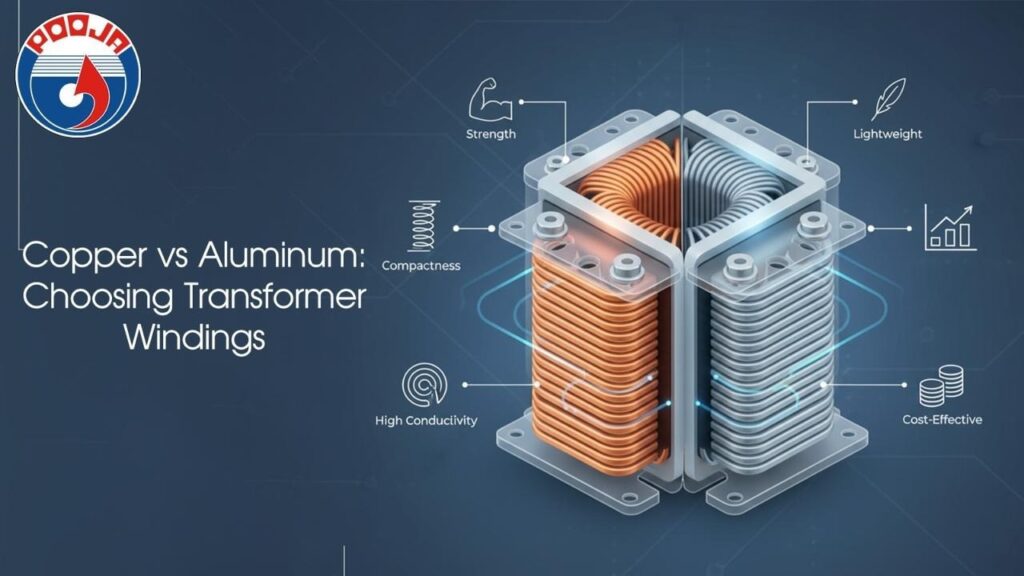
Every transformer manufacturer and customer has faced this dilemma. Both conductors serve the same purpose, yet once current begins to flow, their differences become clearly evident
At Pooja Electrotech, we’ve worked with both materials over the years. The right choice always comes down to the customer’s needs, the design, load, and site conditions.
Current Density and Space Constraints
Copper has higher conductivity – roughly 1.6 times that of aluminum. That means for the same current, an aluminum winding will need a larger cross-sectional area to keep losses equal. Because of this, aluminum windings take up more space, and the transformer body needs to be slightly bigger to handle the same rating. Copper gives you a more compact design for the same load losses, especially in high-current transformers.
Thermal and Mechanical Strength
Thermally, copper handles overloads better. It expands less with temperature, so the joints stay tight and reliable even after years of operation. Aluminium, on the other hand, expands more and is softer, which means its terminals need careful design — with proper contact pressure and anti-oxidation treatment. When that’s done right, aluminium windings can work just as reliably for years.
Copper also has a much higher melting point (about 1083°C compared to 660°C for aluminium). This helps copper withstand more heat and mechanical stress. That’s why copper-wound transformers usually offer better short-circuit strength and longer service life.
Weight and Cost Factors
Aluminium has a density of about 2.7 g/cm³, nearly one-third that of copper (8.96 g/cm³), making it significantly lighter. It is also roughly 40% more economical, which is why aluminium windings are widely used in large distribution transformers to reduce both cost and overall weight. Copper, though expensive, gives better efficiency and mechanical rigidity, making it ideal for power transformers and heavy-duty applications.
Our Engineering View
There’s no single “better” material — only the right one for the job. For high-jerk loads, critical operations, or space-constrained transformers, copper is usually the preferred choice. For cost-sensitive projects or large outdoor units, aluminium works perfectly well.
At Pooja Electrotech, we base every decision on data – current density, temperature rise, and mechanical strength — not assumptions. That’s how we ensure our transformers deliver reliable performance and long service life, no matter which conductor is wound inside.


