
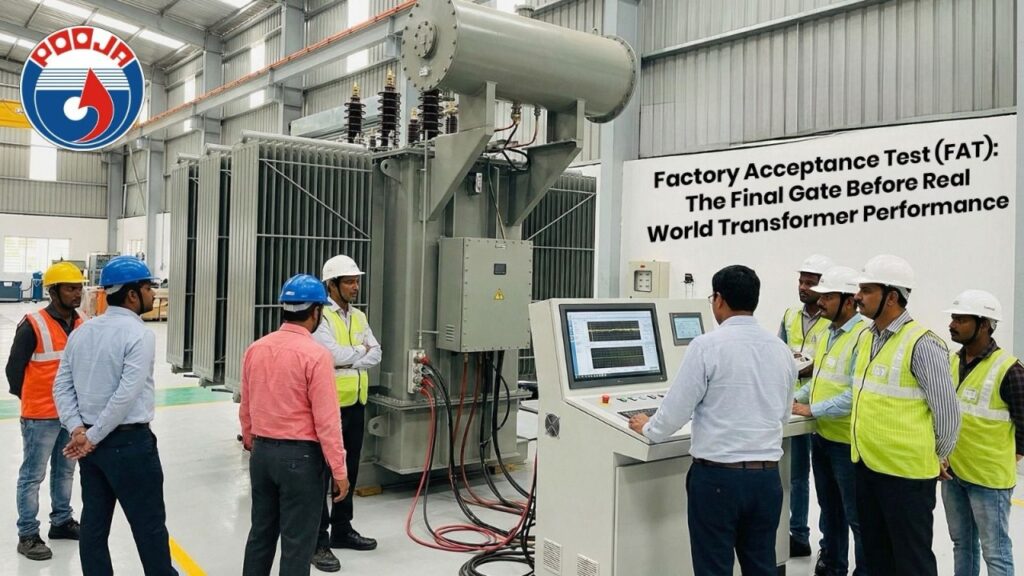
At Pooja Electrotech Private Limited, we conduct Factory Acceptance Tests (FAT) for every transformer we manufacture. We welcome clients, engineers, consultants, and third-party inspectors to physically visit our facility for the FAT. For those unable to travel, we also offer the option of a live online FAT.
After months of design, core building, winding and assembly, one question determines everything: Will the transformer perform as expected once energized at site? The Factory Acceptance Test (FAT) exists to answer this. It is not a formality—it is the final and most crucial validation before dispatch.
What is FAT?
FAT is a complete mechanical, electrical and functional evaluation conducted at the manufacturer’s facility. It ensures that the transformer aligns with customer specifications, meets IEC/IS/IEEE standards and performs reliably under simulated real-world conditions. Just like a test drive confirms a car’s performance, FAT confirms the readiness of a transformer.
Why FAT Matters
Any issue found at site leads to delays, extra cost and unnecessary disputes. A thorough FAT detects problems early, reduces commissioning time, improves reliability and gives customers confidence that the transformer will perform safely and consistently.
What Engineers Verify During Transformer FAT
The process begins with a detailed mechanical and visual inspection. Engineers check the core-and-coil assembly, tank quality, bushings, OLTC mechanism, accessories and nameplate details. This ensures the transformer matches the approved design in both build quality and configuration.
Electrical tests verify the heart of the transformer’s performance. These include winding resistance, turns ratio, vector group confirmation and insulation health checks through IR and PI measurements. Performance tests such as loss measurement, impedance, magnetic balance and high-voltage insulation tests confirm the transformer’s ability to operate reliably under real stresses.
The OLTC is tested for proper contact resistance, smooth motor-driven operation, correct tap sequencing and functioning of alarms and interlocks. Protection and control devices—including Buchholz relays, PRD/OSR, WTI/OTI indicators and oil level alarms —are checked to ensure the transformer responds correctly during abnormal conditions.
FAT concludes with documentation verification, ensuring that test reports, drawings, wiring diagrams and manuals fully match the delivered equipment.
Final Take
A well-performed FAT safeguards the project schedule, installation process and customer trust. When an engineer signs the FAT report, they are approving not just a transformer—but confidence, safety and readiness for real-world operation.
FAT is the final gate. Pass it with precision.


