
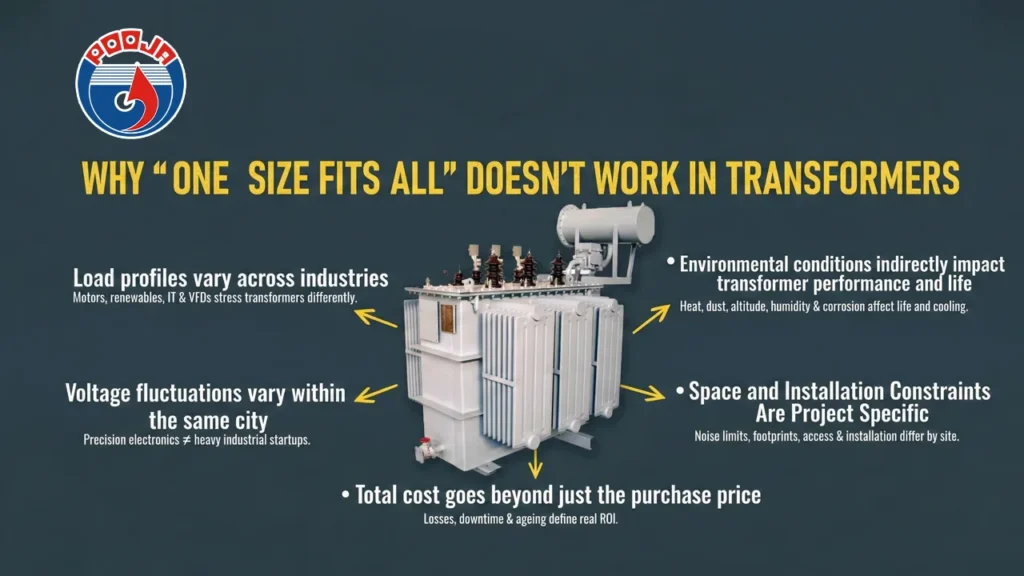
When specifying electrical infrastructure, transformers are often treated as catalog items—selected by kVA rating and voltage level. This commodity mindset overlooks a critical truth: transformers are not generic equipment. Every application brings its own electrical behavior, environmental exposure, and operational priorities. Ignoring these differences often leads to inefficiencies, premature failures, and higher lifecycle costs.
Here are five reasons standardized transformers rarely deliver optimal results.
1. Load Profiles Differ Widely Across Industries
Manufacturing plants deal with high inrush currents from motors and cyclic loading tied to production. Renewable energy sites face bidirectional power flow and fluctuating generation. Commercial buildings introduce harmonics from LEDs, VFDs, and IT systems.
A transformer designed for steady industrial loads may struggle in a solar plant—and one optimized for office buildings can fail early under repetitive motor starts.
2. Environmental Conditions Directly Impact Transformer Performance and Life
Coastal installations face corrosion from salt-laden air. High-altitude sites suffer reduced cooling efficiency. Desert locations experience extreme temperature swings and dust ingress. Indoor substations have entirely different thermal needs than outdoor, monsoon-exposed units.
Standard designs assume “normal” conditions—conditions that rarely exist in the real world.
3. Voltage Regulation Needs Are Not Universal
Sensitive electronics may require voltage control within ±2%. Utilities must manage long feeders with varying loads. Mining and heavy industry demand transformers that tolerate deep voltage dips during equipment startup.
No single impedance or tap configuration can satisfy all these competing requirements.
4. Space and Installation Constraints Are Project Specific
Brownfield upgrades come with tight footprints. High-rise developments demand compact, low-noise solutions. Remote sites may lack crane access, requiring modular or sectional designs. Urban substations must meet strict noise and safety norms.
Generic designs simply cannot adapt to every physical and logistical reality.
5. Total Cost of Ownership Extends Far Beyond Purchase Price
Transformers operating near thermal limits age faster—cutting a 25-year life to 15 years or less. Poor voltage regulation increases system losses. Unmanaged harmonics raise temperatures and stress connected equipment.
The cost of downtime alone can dwarf any upfront savings from a “standard” unit. In many cases, a thoughtfully engineered transformer pays for itself within a few years through energy savings, reliability, and longer service life.
An Engineering-First Perspective
At Pooja Electrotech, we’ve seen these challenges across industrial, commercial, and utility projects in India and abroad. Our work typically begins with understanding how a transformer will actually be used—load behavior, site conditions, environmental exposure, and long-term operating goals.
This approach leads to designs that are better matched to real-world duty: optimized cores and windings, appropriate thermal margins, calculated impedance, and protection aligned with the installation environment.
The result isn’t just a transformer that works—it’s one that lasts longer, operates more efficiently, and reduces risk over its lifetime.
When was the last time you reviewed whether your transformer was designed for your application—or simply selected from a list?


